Showing posts with label planetary science. Show all posts

Monday, August 13, 2007

It's all about water

Okay...as much fun as arguing with the anti-science types is, let's move on.

ScienceDaily has an intriguing little article today called Keeping the Earth's Plates Oiled. I haven't had time to dive into it, but I'll put a few blurbs from it here.

Björn Winker, a mineralogist at the Johann Wolfgang Goethe University in Frankfurt, Germany, believes that the key to the asthenosphere is water. "We have to have water in the asthenosphere to get it plastically deforming," he explains. This water is no longer in its liquid state, but is bound to oxygen in crystal structures to form hydroxyl (OH-) groups instead.

Winkler, and another researcher Refson's study attempts to address the nature of the water through experimentation.
Unfortunately we can't get samples from the asthenosphere ... Winkler finds samples of these candidate minerals on the Earth's surface and...subjects them to the pressures and temperatures estimated for the asthenosphere.

What they found was that...
...clinochlore was found to be good at holding onto water, but showed some interesting changes in its structure at around 8GPa. "The nature of the hydrogen bonds start to change and the layers within the structure slide," explains Refson.

The article then moves on to a separate, but related study.

These kind of results have been invaluable for Hans Keppler, a geologist at the University of Bayreuth in Germany. He has been trying to work out why the asthenosphere exists. Previous theories have suggested that this 'wet' and slippery layer exists because minerals leave their water behind them when they melt and turn into magma. "This explains why the asthenosphere appears beneath oceans, but it doesn't explain why we have an asthenosphere beneath the continents," says Keppler. Lava continually bubbles up at mid-ocean ridges, but continental plates don't have an equivalent spring of constant magma. It also fails to explain why there is a lower boundary to the asthenosphere.


What Keppler found was that...
...water solubility in olivine continuously increases with temperature and pressure, whereas in aluminium-saturated enstatite the solubility reaches a distinct minimum at asthenosphere temperatures and pressures. "It means that the mantle minerals cannot contain all the water and the excess water forms a hydrous silicate melt"

I'm not a mineralogist/petrologist by training, so I honestly can't comment on the details of these studies (I welcome comments from my geoblogger colleagues). But, reading it made me take a step back and think about the question posed at the beginning of the article regarding why the plate tectonics operating on Earth seems so unique. Water is key to subduction, and subduction seems to be what is unique. Other planetary bodies have different forms of volcanism, but not subduction (as far as we know).

These ideas are nothing new (see reference below, for example), but it should be very interesting as we explore other planets in the future. We will be able to put Earth's plate tectonics into a broader context, which will certainly help us understand it better.

Like I said, I'm used to studying modern and ancient Earth surface processes, so I encourage any comments about other papers or ideas out there.


Ragenauer-Lieb, K., Yuen, D. and Branlund, J., The initiation of subduction: criticalilty by addition of water? Science, B. 294, p. 578-580, (October 2001)

image above from here

Wednesday, August 08, 2007

Blog devoted to extrasolar planets

You may have seen the news earlier this week about another discovery of a planet outside our solar system. These discoveries are coming fast and furious these days...it is exciting.

Are you feeling a little unsatisfied after reading the press releases and mainstream news articles? Are you yearning for more information?
Check out the blog Systemic, which is devoted to extrasolar planetary systems. And they don't just post about the latest news, but also are engaged in collaborative research:

The near-term goal of the systemic research collaboration is to improve our statistical understanding of the galactic planetary census. This will be accomplished through a large-scale simulation in which the public is invited to participate. No prior experience or expertise with Astronomy is required. All you need is an Internet connection and a desire to learn and explore.
Not only is Systemic informative, but it is beautifully designed.
Check it out.

Tuesday, July 31, 2007

Shadow of a moon and Kelvin-Helmholtz waves

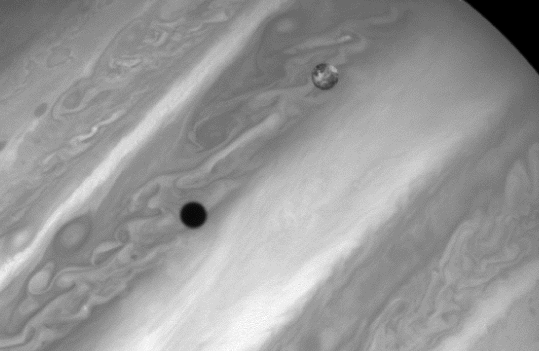
I saw this photo on Terra Que Gira a little earlier. Not only is it a striking photo...I just love that sharp, black circle against the more diffuse and swirly background of Jupiter's atmosphere...but it also shows some nice Kelvin-Helmholtz waves, which are trains of waves typically marking a boundary or interface between two layers or regions of different turbulent behavior (commonly due to different densities). They happen in all kinds of fluids....sometimes you may even see them in clouds on Earth.

In a temporal sense, they commonly define the conspicuously organized transition from non-turbulent (laminar) flow to the much more random behavior of fully turbulent bursts and sweeps.

Check out this movie below of a simulation (click on it to go to movie, then go here for explanation)


Although they do occur in sedimentary features (bedforms), perfectly preserved examples of them are hard to come by.

Read more about the fluid mechanics of Kelvin-Helmholtz instabilities here, here, and here.

Wednesday, July 11, 2007

HiRISE images of Mars

The image above is from the Marte Vallis region of Mars and nicely shows some mass wasting on the hillslopes.

The High Resolution Imaging Science Experiment (HiRISE) is a camera aboard the Mars Reconnaissance Orbiter. The project is part of the University of Arizona and the website is a great portal into high resolution of Mars' surface.

They have a lot of the images tagged by categories such as mass wasting, tectonic processes, fluvial processes, and others. See all the science themes here.

Sunday, June 17, 2007

The media's anthropomorphization of Pluto

A quick survey of mainstream media reporting on Pluto this weekend reveals their continued (and incredibly annoying) obsession with turning Pluto into an conscious being with feelings.


Here a few examples. Note red circles (mine).

The San Francisco Chronicle mentions Pluto's pride. CNN claims the planetary body is suffering from indignity. I guess at least BBC said that Pluto's status suffered a blow, instead of the dwarf planet itself suffering.


What the hell is the problem? Big deal...we've reclassified Pluto. It's a damn label to help science better communicate. This is how it works. The general public (and apparently science reporters too) can't seem to grasp the concept of classification. This is a human-made abstraction to help us better understand natural phenomenon. There is no true organization...at least not in this simplified outline form. Classifications are supposed to be refined, changed, tweaked, tanked, overhauled, etc. over time. This is part of doing science!

Maybe you're saying - 'relax, they're just having fun'. I understand that...yeah, sure it's cute. But if this style of reporting misrepresents how science is done, then I don't find it so cute.

Besides, if people are really worried about the feelings of a planet (dwarf or otherwise), maybe they should ask Earth.


UPDATE: Add SEED magazine to the list too. Apparently Pluto "...got kicked out of the brotherhood of planets and demoted...". Sucks to be you Pluto! Oh wait, Pluto is an inanimate body of rock and ice.

Wednesday, May 02, 2007

Stunning new images of Jupiter and its moons


NASAs New Horizons spacecraft, which is on its way to Pluto, returned some incredible new images of Jupiter and its satellites. Check out the entire BBC article here and go here for more images.

The craft was using Jupiter as a slingshot to get out to the outer solar system as was able to get these images during the process. The above image shows the Little Red Spot (which is as big as Earth), a gigantic storm that scientists have had their eye on for some time.

The image below shows the moon Io in the upper left. The blue plume is from the erupting Tvashtar volcano. Europa, which has amazingly different characteristics is seen in the lower right.

Thursday, April 12, 2007

Inverted depositional features on Mars

FYI - this post is not about brand new discoveries -- you can find information about these features on Mars Global Surveyor website and also check out a Science paper from 2003 by Malin et al. that goes over this stuff in more detail...I just felt like posting about it.

I was living in Colorado some years back when I went on a trip to look at the local geology of the Front Range and had one of those great field moments when the trip leader pointed out some inverted topography. In this case, a relatively small volcanic eruption produced lava flows that were isolated in a mountain valley. Since that time, the surrounding much softer sediments and sedimentary rocks have eroded away leaving lava-capped mesas that are now segmented by the modern river. The image below is of Golden showing the modern Clear Creek cutting the lava-capped mesa in two (yes, that complex of structures right in the valley is Coors brewery). Image courtesey of www.tablemountains.org.

These modern positive topographic features are representing an ancient valley! Very cool.

So, while wasting time on the internet - in 7-minute increments - I came across some old bookmarks about some inverted topographic features on Mars. The group of features, discovered in November 2003 by Mars Global Surveyor (MGS), have been dubbed the Eberswalde Delta.

The image above is Fig. 2 straight from Malin et al. (2003) showing the exhumed fluvial distributary fan (click on all images for larger view). The conspicuous curvilinear features at closer examination are actually positive topography. Inset of box A below clearly shows the deposits of a migrating meandering stream standing as a plateau above the surrounding area.

This is a striking example of inverted topography. In this case, the channel deposits contain coarser material (likely sand/gravel) and therefore are more resistant than the out-of-channel material (likely mud/silt). No data from the planet surface exists for this location but these are reasonable guesses. The cross-cutting relationships of this feature also nicely reveal that the wide meander swing was abandonded for a shorter, more direct route at some point.

The image below (inset box B) shows more cross-cutting ridges representing channel-fill deposits. I would sure like to walk up the edges of those ridges and plateaus to check out the cross-section of that fill. Another thing to notice is the apparent spreading out of coarser-grained material from left to right. Malin et al. interpret this as the lobe deposits at the end of these channel features....which seems pretty reasonable to me.


The implications of all this, of course, are further evidence of flowing water on Mars. The big problem we are faced with at this point is not so much if water flowed on Mars, but when. The next generation of rovers are gonna half to brush up on their geochronology.

Wednesday, December 06, 2006

Why does it have to be water?

Okay, I know...another Mars post.
But, earlier today the news agencies picked up on a story about features seen on Mars that may have been formed by liquid water. The image at right is zoomed in on one of these deposits. The lighter-colored material is being interpreted as possibly the result of flowing water.

Why does water need to be involved at all? In fact, why does liquid need to be involved? Depending on the material that makes up this steep slope, it could simply be a gravity failure of loose, granular material that flowed and created this deposit. Sand dunes do this all the time. What is the gravity like on Mars compared to Earth anyway....how might loose, granular material behave?

My point is that water is not necessarily required to produce this feature.

What's worse is that once the words 'water' and 'Mars' are spoken in the same sentence, reporters and newspapers make giant leaps of inference and start talking about 'life on Mars'.

Granted, I haven't actually read the scientific report that is coming out....my guess is that the news is overstating what the authors may be implying in their work.

Tuesday, November 28, 2006

Mars Global Surveyor...R.I.P. (1996-2006)

© 2006 by Malin Space Science Systems, Inc.

NASA lost contact with the Mars Global Surveyor (MGS) nearly a month ago. It appears it is now lost. MGS had a good run...orbiting the red planet taking high-res photos of the surface. It contributed to the success of the Rover mission by helping find landing spots.

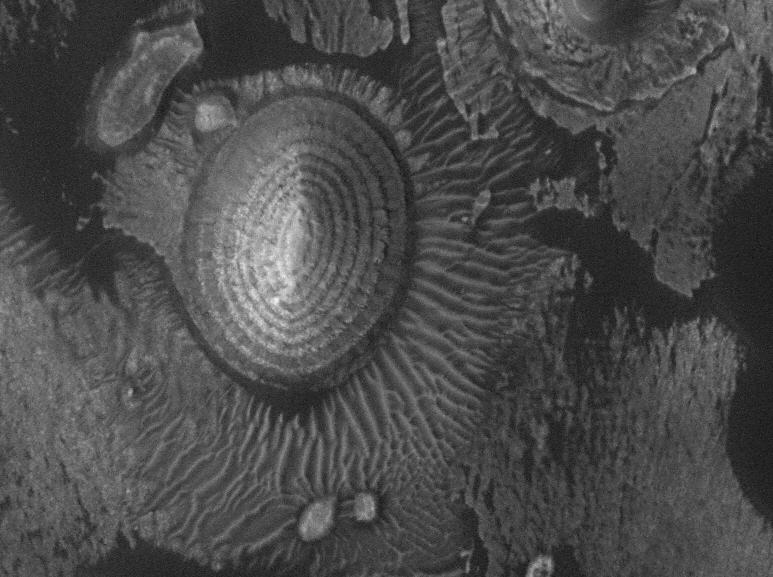
The above photo shows flat-lying sedimentary rocks eroding into an oval-shaped hill that has linear sand dunes around it.

Check out the online database of MGS images.

Monday, November 13, 2006

Giant storm on Saturn

nasa.gov

This hurricane-like storm is 5,000 miles across (about 2/3 the size of Earth) with estimated winds of 350 mph. Click here to read more about it. Also note in the blue and red images above...all those spots are smaller storms within the big one!

Wednesday, October 11, 2006

Opportunity at Victoria Crater


These crazy robots are still alive and kickin' on the surface of Mars...they were only supposed to survive a few months but have been there exploring and collecting data since early 2004 . One of the two rovers, Opportunity, just reached the edge of a crater that has some rocks exposed along the crater walls (picture above).

Check here for more.

Tuesday, September 26, 2006

The Face on Mars

Modern mapping and imaging of the surface of Mars reveals "the face".
Read the article here.