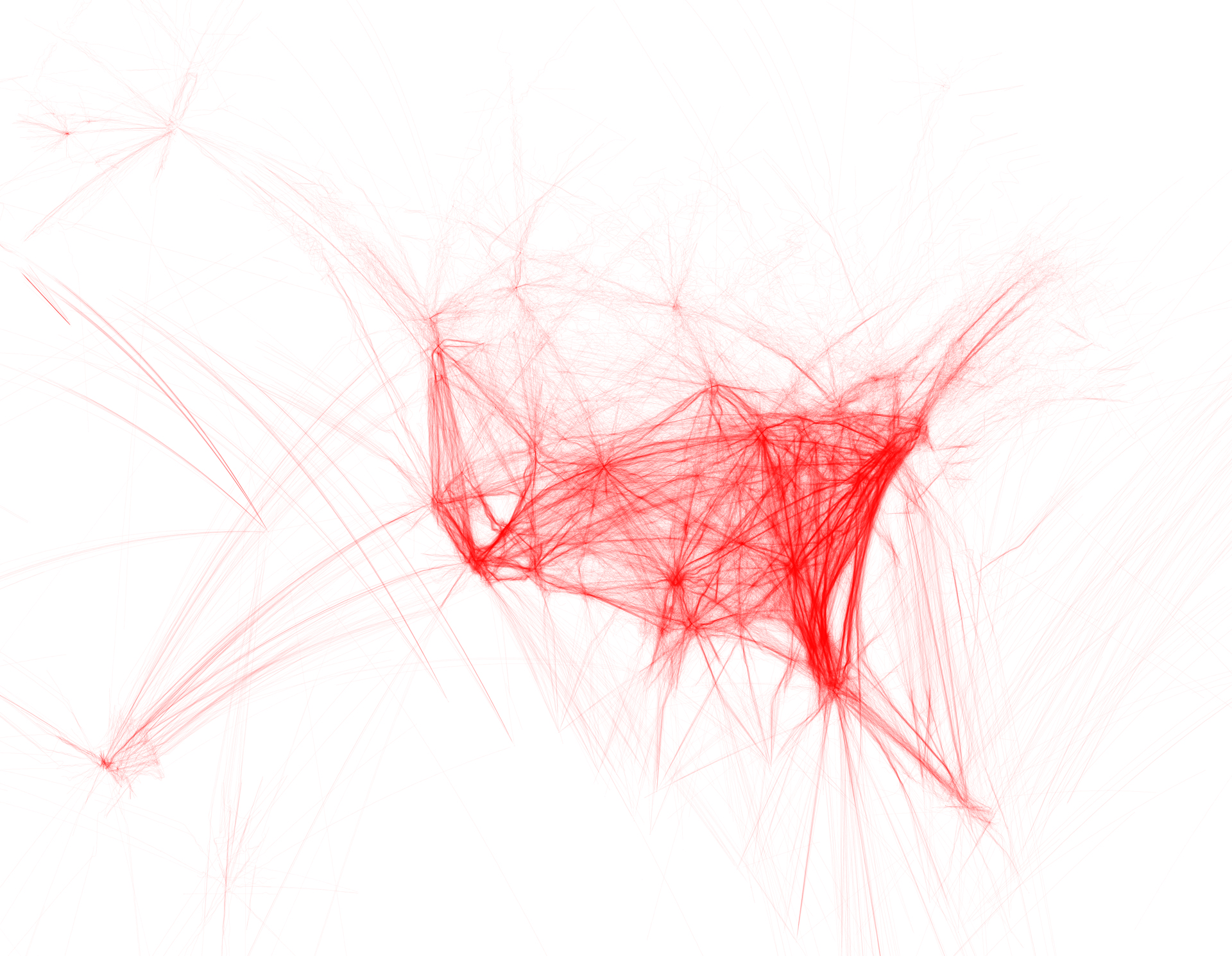
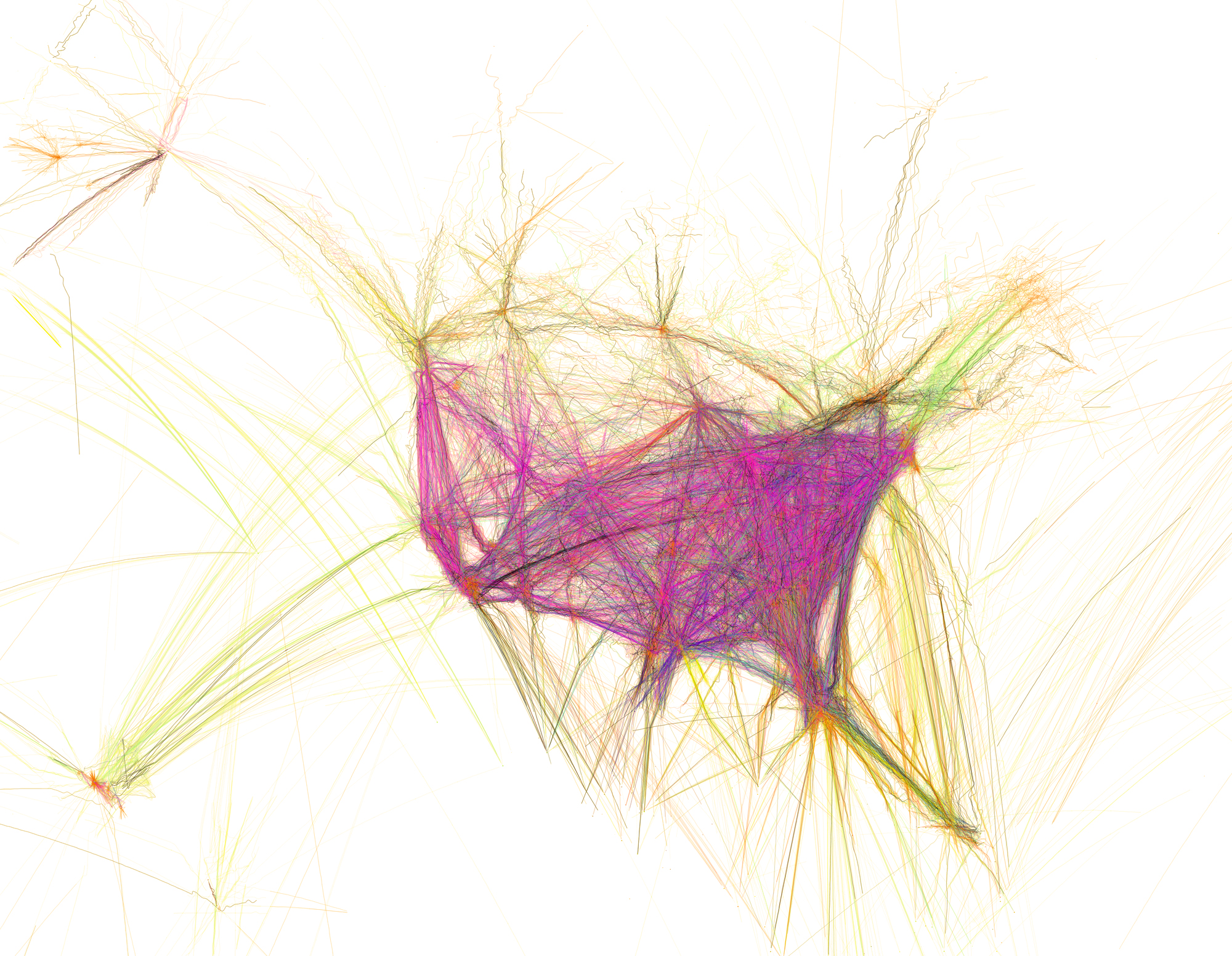
Spectacular visualization of flight patterns

Here are a few of the images....check out the site for more.
The look and feel of the work reminds of the Cabspotting project that I posted about several months ago.

Here are a few of the images....check out the site for more.
The look and feel of the work reminds of the Cabspotting project that I posted about several months ago.
 The previous post showed the sedimentary structure climbing ripple cross-lamination as it appears in a preserved deposit. This post links you to a fantastic video showing plan-view ripple migration in time lapse.
Unfortunately, I couldn't get this movie embedded so when you click on the screenshot at right it will take you to the USGS website where its hosted.
The movie shows a 40x60 cm area looking down on an active ripple field in a flume experiment. It is created from photographs taken once every 40 seconds for six hours. The bedforms migrate from top to bottom.
Note that these are not the highly aggradational ripple bedforms shown in the last post, but your run-of-the-mill migrating ripples.
What's interesting when watching the time lapse is how uneven the pace of the migration is. There seems to be spurts of faster-migrating ripple crests, usually in a relatively narrow strip, every so often. I don't know if the flow speed in the flume was kept constant...it doesn't say either way...but, I'm presuming it was.
Check out the index page for more movies and illustrations of bedforms in action.
I found a couple videos of starlings flying in incredibly dynamic flocks. They seem to create one larger collective organism. I would love to see this in person some day.
This first video, from England, actually has some narration about the birds during the first half.
This second video is much shorter and shot in Rome.
Watching these complex patterns is simply mesmerizing. Enjoy!
I came across this interesting website, called Visual Complexity, that has a collection of images from various projects that aim to map and produce visualizations of complex networks. These include biological, computer systems, social networks, the web itself, and others.
The image below is a map of the blogosphere from here. The value of these to me aren't so much in using them as a map....as in to navigate the blogosphere with the above image....but to appreciate the nature of networks.
Back in February during Just Science Week, I posted a bit about some of the work being done regarding experimental sedimentation (see here).
I highlighted the work being done by sedimentologists and dynamicists at the University of Minnesota's St. Anthony Falls Lab in particular.
The video below is from some of their work...I encourage you to explore their data archive if you want to find more. This video shows a time lapse of sedimentation occuring on an experimental delta. This particular experiment nicely shows the dynamics of shifting pathways of sediment transport and/or deposition/erosion, otherwise known as avulsion. The deposit here would be more akin to a braided fan delta as it is not developing long-lived channels with cohesive levees.
The annotation shows where and when avulsion and expansion of channelized flow occurs. Also keep your eye on where deposition is occuring. This interplay of deposition and avulsion continues in a very dynamic (and seemingly unpredictable) fashion. Qualitatively, this isn't really anything we haven't known for a long time. The point with these experiments is that we can measure every last little detail. These researchers are really just scratching the surface -- eventually they would like to try develop some fundamental quantitative relationships that might lead to predictive guidelines. But, it will take many years of experimentation to amass the data needed to converge on these relationships.
The photo below is shown on SAFL's web page currently...it shows that they are now experimenting with systems that do produce cohesive levees, which is a key ingredient for understanding the dynamics of most river deltas.
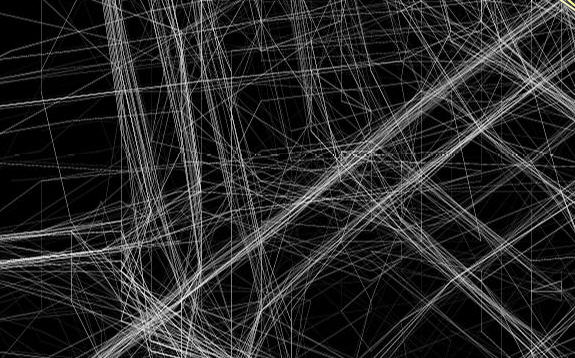
The Exploratorium is a science museum in San Francisco that aims to mix science with culture and art. One of their sponsored projects, shown in the image above and called Cabspotting, tracks the movements of taxi cabs around the city. It creates an ever-changing map revealing some interesting cultural and social trends. Plus, I think it just looks cool.
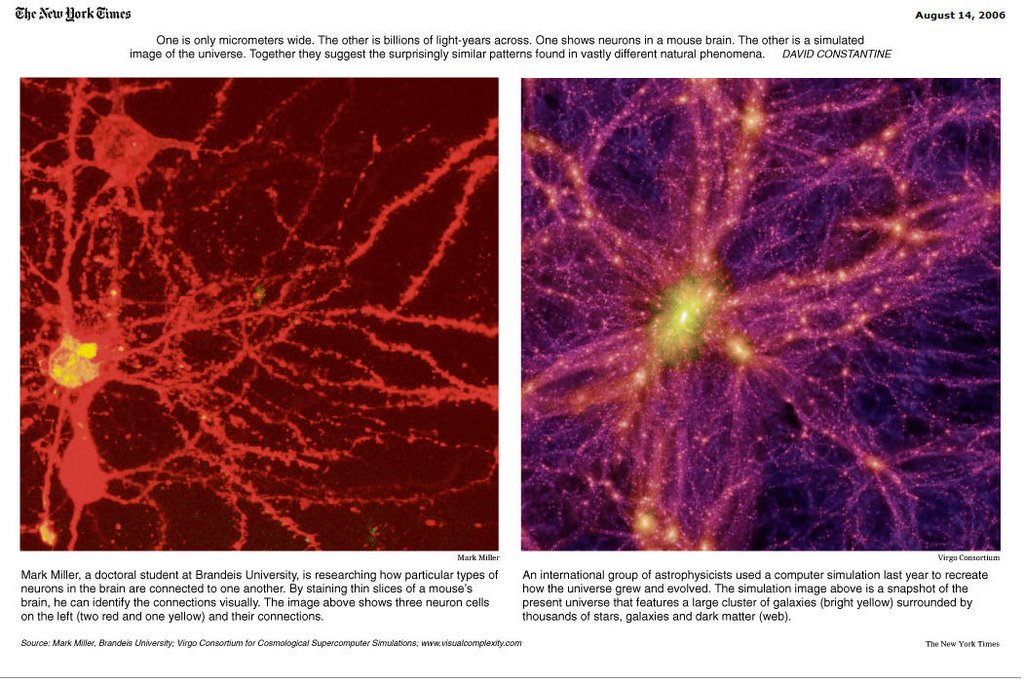
Click on the image above to get a bigger version. It's a screenshot from a NYT article back in August showing a neuron cells and their connections in the brain on the left and simulation of the universe on the right.